If you work in a hospital, clinic, school health office, or emergency setting in Livermore, CA, you have probably run into all three acronyms in a job posting or onboarding checklist: BLS, ACLS, and PALS. They are related, but not interchangeable, and choosing the wrong one can mean redoing paperwork or delaying a hire. In most cases, BLS CPR certification is the starting point for every healthcare role, while ACLS and PALS build on it for specific patient populations. This guide breaks down what separates the three so you can match the right course to your job duties before you register.
Key takeaway: BLS is the foundational certification nearly every healthcare worker in Livermore needs first, since it covers core CPR and AED skills for adult, child, and infant patients. ACLS adds advanced adult cardiac care for providers who manage cardiac arrest and cardiovascular emergencies, while PALS applies those same advanced concepts specifically to infants and children. Your job duties and patient population, not personal preference, should drive the decision.
What BLS, ACLS, and PALS Actually Cover
Basic Life Support (BLS) teaches high-quality CPR, AED use, relief of choking, and team-based resuscitation for adults, children, and infants. It is built for anyone who might be the first person to respond to a cardiac or respiratory emergency, which is why it applies broadly across nursing, dental, EMS, and allied health roles.
Advanced Cardiovascular Life Support (ACLS) goes further, adding cardiac rhythm recognition, airway management, and medication protocols used during adult cardiac arrest and cardiovascular emergencies. Pediatric Advanced Life Support (PALS) mirrors that advanced skill set but applies it to infants and children, whose airways and physiology differ from adults in ways that change how a team responds.
All three certifications are typically valid for two years from the completion date, though your employer or licensing board should confirm the exact renewal window that applies to your role.
Why BLS Is Usually the Starting Point
Most healthcare employers treat BLS as a prerequisite before staff move on to ACLS or PALS, since advanced courses assume you already know how to perform effective CPR and use an AED under pressure. If you are a new nursing student, medical assistant, dental hygienist, or someone entering a clinical rotation in the Livermore area, BLS is almost always the first box to check.
ACLS and PALS courses move quickly through advanced material and expect participants to arrive with solid baseline CPR skills already in place, which is why trying to learn foundational compressions and advanced protocols at the same time makes both harder to absorb.
When ACLS Becomes the Right Next Step
ACLS makes sense once your role involves directing or actively participating in the response to adult cardiac arrest, stroke, or acute cardiovascular events. This typically includes nurses in emergency departments, ICU staff, cardiac catheterization lab teams, paramedics, and physicians who lead resuscitation efforts.
If your work is mostly outpatient or administrative and rarely involves adult cardiac emergencies, ACLS may not be required even if a coworker in another department needs it. Confirming this with your supervisor is more reliable than guessing based on job title alone.
How PALS Differs From ACLS in Practice
PALS is not simply “ACLS for kids.” Pediatric patients respond differently to airway obstruction, respiratory distress, and shock, so the course covers pediatric assessment tools, age-based medication dosing, and modified compression and ventilation techniques for infants and children.
Roles that commonly require PALS include pediatric nursing, pediatric emergency departments, school nursing, NICU and PICU staff, and EMS providers who regularly transport pediatric patients. Some workers hold both ACLS and PALS because their patient population spans adults and children, such as staff in a general emergency department.
Comparing the Three Courses Side-by-Side
- BLS: Core CPR, AED use, choking relief. Applies to adult, child, and infant patients. Required broadly across healthcare roles.
- ACLS: Advanced cardiac interventions, rhythm recognition, and medication protocols. Applies to adult patients. Typically required for emergency, ICU, and cardiac-focused roles.
- PALS: Advanced pediatric assessment and intervention. Applies to infant and child patients. Typically required for pediatric, NICU, PICU, and school-nursing roles.
If your role touches more than one of these categories, ask your employer directly which certifications your position requires rather than assuming based on similar roles elsewhere.
What to Expect During Hands-On Skills Training
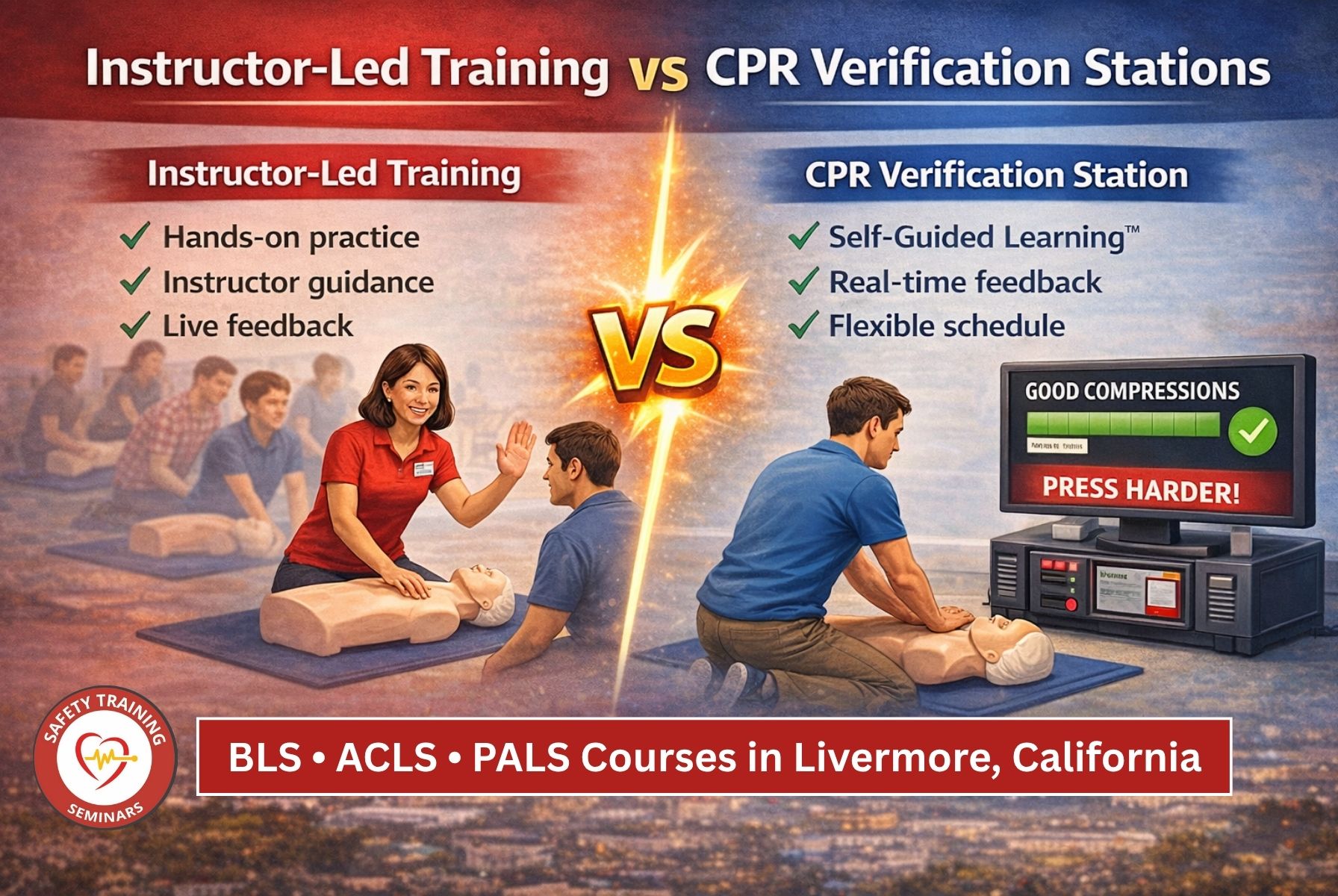
Whether you take BLS, ACLS, or PALS, expect a mix of instructional content and hands-on skills practice on a manikin, since these courses are built around demonstrating competency rather than just passing a written test. Some providers offer a blended format where you complete the cognitive portion online before attending an in-person skills session to be evaluated. If your employer requires a specific format, confirm that before you register so the certification you earn is accepted without extra steps.
Choosing a Course Near Livermore’s Tri-Valley Healthcare Community
Livermore sits within a healthcare and education corridor that includes hospitals, clinics, schools, and senior care facilities throughout the Tri-Valley and greater East Bay. Nursing students commuting from Pleasanton, allied health staff in Oakland, and school health professionals in San Leandro often need the same certifications but on different timelines tied to clinical rotations, hiring dates, or renewal deadlines.
Because classes fill up around common renewal cycles, it helps to confirm your certification status well before a deadline rather than searching for a same-week class. Reviewing BLS, ACLS, and PALS course options for Pleasanton healthcare workers or certification courses available to Oakland-area providers can help if Livermore timing does not line up with your own.
Where to Review Local Course Details
Safety Training Seminars operates a training center in Livermore, CA, at 3195 Independence Drive, Suite 1, Livermore, CA 94551, offering BLS, ACLS, and PALS courses along with CPR, First Aid, and NRP training. For workers who prefer completing certification close to home rather than traveling into denser parts of the East Bay, reviewing course dates and format details before enrolling helps confirm the class fits your work schedule and employer requirements.
Staff who split time between Livermore and neighboring communities sometimes compare availability across locations. If your schedule works better elsewhere, CPR, BLS, ACLS, and PALS class options in Newark or training courses available to San Leandro healthcare staff are worth a look. Whichever location you choose, confirm with your employer or licensing board that the format you select meets their requirements.
Frequently Asked Questions
Do I need BLS before I can take ACLS or PALS? Most training providers expect you to have working CPR skills before an ACLS or PALS course, since advanced material builds directly on BLS technique. Some employers require an active BLS card on file, while others only expect proficiency. Confirm your employer’s specific policy, since requirements vary by organization.
Can I complete these certifications through an online-only course? Many BLS, ACLS, and PALS courses use a blended model combining online coursework with an in-person skills evaluation, since hands-on competency typically needs to be demonstrated in person. Check with your employer or school before assuming a fully online certificate will be accepted.
How do I know if my role in Livermore requires ACLS, PALS, or both? This depends on your patient population and unit, not just your job title. Emergency department and ICU staff often need both if they treat adults and children, while pediatric-specific roles typically require PALS alone. Ask your supervisor or HR department to confirm which certifications apply to your position.
Are BLS, ACLS, and PALS classes available near Livermore for people commuting from surrounding cities? Yes, healthcare workers and students from communities including Pleasanton, Dublin, Union City, and Castro Valley regularly attend training near Livermore rather than traveling into denser parts of the Bay Area. Checking schedules in advance is especially useful during peak renewal periods.
What should I bring to a BLS, ACLS, or PALS course? Bring a government-issued photo ID and comfortable clothing for hands-on skills practice. If you are renewing a certification, bring your current card, since some courses use it to verify your prior training level. Contact your training provider beforehand to confirm any additional requirements.
Making Your Next Step Clear
Deciding between BLS, ACLS, and PALS comes down to one question: which patients does your role require you to respond to, and at what level of intervention? BLS covers the broad foundation almost every healthcare worker in Livermore needs, while ACLS and PALS apply once your job involves directing advanced care for adults or children specifically. Confirming your employer’s exact requirement before you register saves you from taking the wrong course or having to repeat one.
Safety Training Seminars’ Livermore location offers BLS, ACLS, and PALS courses for healthcare workers throughout the Tri-Valley area. If you are ready to move forward, review current course availability and format details at the Livermore training center, or compare nearby options if your schedule points you toward a different location instead.