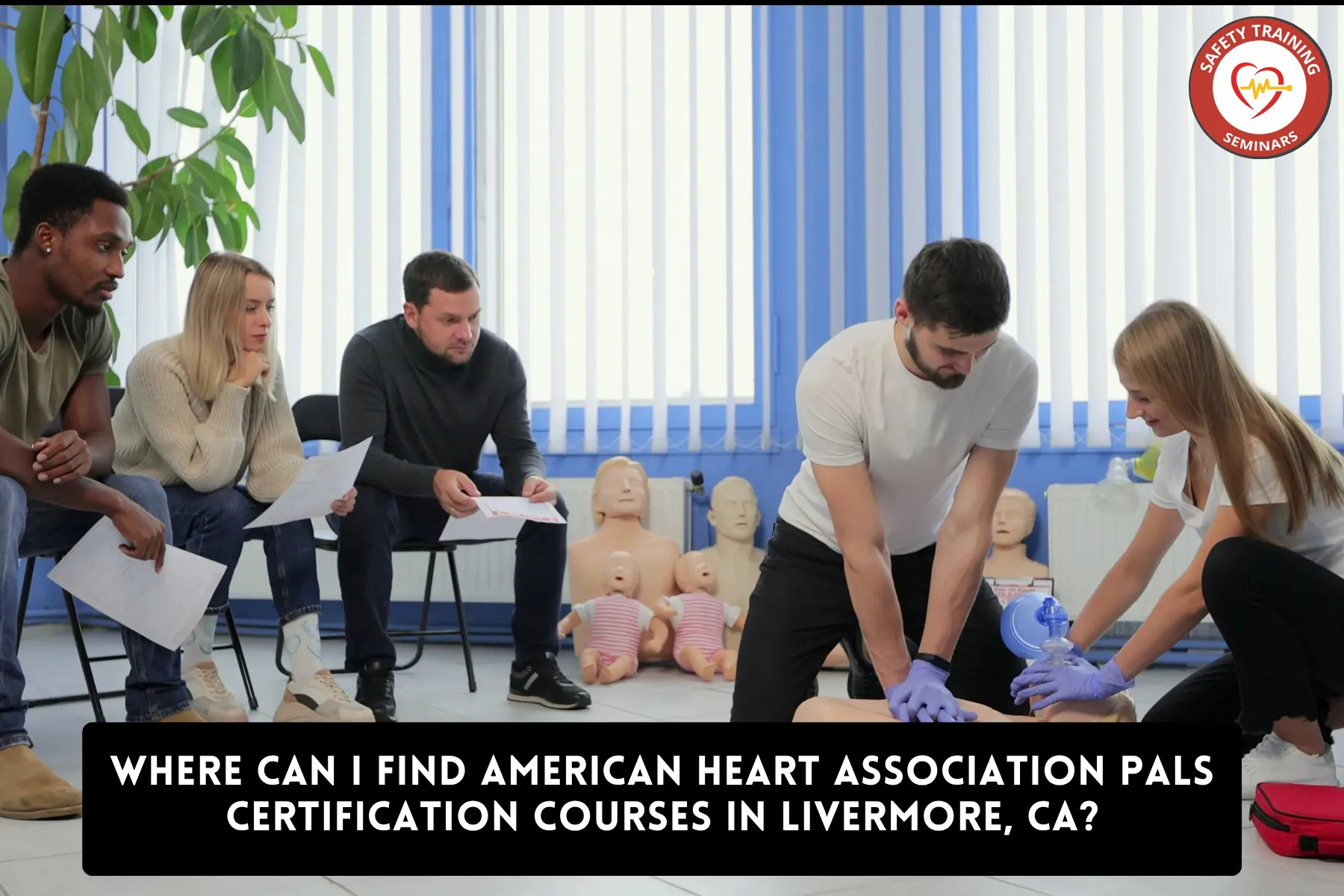
You can earn American Heart Association PALS certification in Livermore at Safety Training Seminars, an AHA training site on Independence Drive in north Livermore. The center offers PALS as a blended course. You complete the cognitive portion online through HeartCode® Complete or the Self-Guided Learning™ pathway, then visit the Livermore site for a short hands-on skills session. Learners who pass both parts receive an official AHA PALS Provider Course Completion eCard the same day.
The sections below cover who in the Tri-Valley usually needs PALS, how it compares with related life support courses, what your skills appointment involves, and what the course currently costs.
Who in the Tri-Valley Searches for a PALS Class
PALS (Pediatric Advanced Life Support) is an advanced course for clinicians who may need to stabilize or resuscitate an infant or child. In and around Livermore, most learners fall into three groups.
Hospital-Based Clinicians
Stanford Health Care Tri-Valley, formerly ValleyCare, is the main hospital system serving Livermore, Pleasanton, and Dublin. It has a campus on East Stanley Boulevard in Livermore and its main hospital and emergency department in Pleasanton. Through a collaboration with Stanford Children’s Health, pediatric specialists from Lucile Packard Children’s Hospital provide round-the-clock inpatient pediatric hospitalist and neonatology care at the Tri-Valley hospital.
Emergency, inpatient, and critical care nurses, respiratory therapists, and physicians who work in these settings are among the most common PALS learners in the region.
EMS Providers and Paramedic Students
Livermore is home to the Las Positas College Paramedic Program, an 18-month program approved by the California EMS Authority and the Alameda County EMS Agency. In early 2026, the program received accreditation from the Commission on Accreditation of Allied Health Education Programs (CAAHEP).
Paramedics, paramedic students, and newly hired medics often add PALS to their credentials, because pediatric calls are among the highest-stress situations in the field. Requirements vary by program and agency, so confirm exactly which certifications your school or employer expects and when.
Outpatient and Urgent Care Staff
Clinicians in pediatric offices, urgent care centers, and outpatient procedure settings across Livermore, Pleasanton, and Dublin may also be asked to hold PALS, especially where procedural sedation is performed.
How PALS Compares With Other Life Support Courses
Many people searching for a PALS certification course in Livermore aren’t sure whether they need PALS, ACLS, NRP, or just BLS. This table shows how they differ.
| Course | Patient Population | Who Typically Takes It | Issuing Organization |
| BLS | All ages | Nearly every clinical role; the foundation for the other courses | American Heart Association |
| PALS | Infants and children | Pediatric, ED, ICU, EMS, and sedation providers | American Heart Association |
| ACLS | Adults | ED, ICU, telemetry, EMS, and anesthesia providers | American Heart Association |
| NRP | Newborns at and shortly after birth | Labor and delivery, nursery, and NICU teams | American Academy of Pediatrics |
Many emergency department and EMS roles call for BLS, ACLS, and PALS together. Neonatal and obstetric teams often need NRP. The Livermore training center offers all four courses, which makes it easier to coordinate renewal dates if you hold more than one card.
What PALS Teaches
PALS is designed around early recognition. In children, cardiac arrest more often follows progressive respiratory failure or shock than a sudden cardiac event. The course trains providers to catch that decline and intervene before arrest.
Major topics include:
- A systematic pediatric assessment sequence
- Classifying respiratory problems by type and severity
- Identifying shock and responding with appropriate fluid and medication therapy
- Managing pediatric bradycardia and tachycardia
- Cardiac arrest algorithms, defibrillation, and weight-based drug dosing
- Care after return of spontaneous circulation
- Resuscitation team roles and communication
Your Livermore PALS Appointment, Start to Finish
The blended pathways used at the Livermore site split PALS into two parts.
Part 1: Online Learning at Home
You register for either HeartCode® Complete PALS or the Self-Guided Learning™ PALS pathway, then complete the online coursework at your own pace. The self-guided version uses True Adaptive™ learning powered by Area9 Lyceum, which adjusts the material to what you already know. The training center estimates the online portion at about two to three hours, though first-time learners may take longer.
Part 2: Skills Session on a CPR Verification Station™
Next, you schedule a skills appointment at the Livermore center, which the site estimates at about 30 minutes. You perform the required resuscitation skills on a manikin-based CPR Verification Station™ that measures compression depth, rate, ventilation, and AED use against AHA standards. Feedback is immediate. When you pass, your eCard is issued the same day.
If You’re Renewing
Providers with a current PALS card can choose the renewal pathway. It reinforces updated algorithms, rhythm recognition, and team communication, followed by the same skills verification.
Training Center Location and Contact Details
Safety Training Seminars hosts PALS skills sessions at 3195 Independence Drive, Suite 1, Livermore, CA 94551. The center describes the site as near the Independence Drive and Portola Avenue intersection, with access from Interstate 580 and parking available.
The I-580 corridor makes the location reachable for clinicians from Pleasanton and Dublin to the west and from Tracy to the east, which the center lists among the communities it serves.
According to the center’s website:
- Phone: (925) 338-7733
- Listed hours: Monday through Sunday, 8 a.m. to 10 p.m.
- Courses offered on-site: BLS, ACLS, PALS, NRP, CPR and first aid, and California childcare-provider training
The Livermore PALS certification course page has current enrollment options and booking links for each PALS pathway.
What Does PALS Cost in Livermore?
At the time of writing, Safety Training Seminars listed its AHA PALS course at $290 on the Livermore website. The site also advertised a $25-off promotion on AHA BLS, ACLS, and PALS courses using promo code Flash25. Prices and promotions change, so confirm current pricing at checkout.
Some employers reimburse PALS fees or pay for training directly. Check your organization’s education benefits before you register.
Preparing So the Skills Session Goes Smoothly
A little preparation goes a long way, especially if you’re new to PALS or haven’t used the algorithms in a while:
- Review your BLS skills. High-quality infant and child CPR is the baseline for everything in PALS.
- Practice rhythm identification. Sinus tachycardia versus SVT and the arrest rhythms are frequent sticking points.
- Know your medications. Learn when epinephrine, adenosine, amiodarone, and atropine are indicated and how weight-based dosing works.
- Bring your online completion certificate. You’ll need proof that you finished Part 1 before starting the skills session.
Frequently Asked Questions
Can paramedic students take PALS before they finish their program?
Yes. AHA PALS is open to healthcare providers and students in healthcare training programs. Whether a PALS card earned before graduation satisfies your program or future employer depends on their policies, so check with your program director or hiring agency.
How early can I renew my PALS card?
You can renew any time before your current card expires. Your new two-year card is dated from the day you complete the renewal, so many providers renew a month or two early to avoid a lapse.
Is the HeartCode PALS card the same one hospitals accept for classroom courses?
Yes. HeartCode® Complete and classroom PALS both result in the same AHA PALS Provider Course Completion eCard. Employers see a single, standardized credential.
Do I need PALS if I already have NRP?
It depends on your patients. NRP covers newborn resuscitation in the delivery setting, while PALS covers infants and children beyond the immediate newborn period. Clinicians who care for both groups are often asked to hold both certifications.
How long is a PALS certification valid?
AHA PALS Provider eCards are valid for two years. Set a calendar reminder well before the expiration date, because credentialing offices often require proof of renewal before your card lapses.
Getting Started With PALS in Livermore
Livermore-area providers can complete American Heart Association PALS without leaving the Tri-Valley. Choose HeartCode® Complete or Self-Guided Learning™ for the online portion, then finish your skills check at the Independence Drive training center and receive your eCard the same day. If you’re renewing BLS, ACLS, or NRP at the same time, you can see the full course lineup on the Livermore CPR, BLS, ACLS, and PALS classes homepage, or call (925) 338-7733 to ask about scheduling.